YouTube Call to Action: Six Types and the Timing Rule That Keeps Viewers Engaged
Why flinching at the ask is quietly costing you engagement
There is a small moment I suspect you know well. The edit is done, the audio is clean, the thumbnail is sitting in a folder ready to go, and then you reach the part where you have to say the words: like the video, subscribe to the channel. And your hand stops. You mumble it. It sounds like begging, and begging makes you feel smaller than you were a second ago.
I did exactly this for my first few years on YouTube. I said the ask into empty air, half-hearted, without believing it myself. Viewers can hear that instantly. They watched to the end, flicked a thumb, and the video was gone. What that view left behind was a perfect zero: no like, no comment, no trace at all that a human being had passed through.
That zero is the part worth worrying about. Engagement is a signal. When people tap, type or stay, the system has something to weigh when it decides whether to put your video in front of the next person. When you say nothing, your audience says nothing back, and the algorithm reads the silence exactly as it looks: a video nobody bothered to respond to. Plenty of channels grind for months without traction, and the content is not the problem. The problem is that nobody was ever actually invited to do anything.
So here is the reframe I want you to take from this article. A call to action done properly is not begging. It is an invitation. You are inviting someone to stay, to speak up, to become part of the thing you are telling. It only collapses into spam when it is greedy, vague or badly timed.
Which leads to an honest question: when was the last time you genuinely invited a viewer to press one specific thing?
If you had to think about that, keep reading. Below are six types of ask, a timing rule so you stop relying on memory, one principle underneath all of it, and a hard line you should never cross.
What a call to action really does, and why the algorithm hears your silence
Stripped down, a call to action is a sentence that tells the viewer what to do next, while they are still watching. It is not a spell and it is not a growth hack. It is you opening your mouth: “type a 1 for me”, “hit like if that jump made you flinch”, “stay for the last two minutes”. Clear, one thing, right now.
So why does a sentence that simple matter? Because YouTube does not see you awake at two in the morning cutting the timeline. It does not see effort. It reads signals. Every like, every comment, every extra second watched is one more input the system can use when deciding whether to show your video to a stranger. Engagement produces signal, and signal produces a chance.
I am using the word “chance” carefully. Nobody, including me, can promise that asking produces views or revenue. It does not work that way. A call to action opens a door for the signal to travel through. How far it travels depends on the content, the market and a fair amount of luck. Anyone guaranteeing you an outcome is selling a daydream.
On a faceless channel the stakes are a notch higher. There is no face for the audience to latch onto, no eye contact, no smile. The only things that touch a viewer are your voice and the moments where you invite them to act. That makes the call to action do double duty: it is not just an ask tacked onto the final ten seconds, it is one of the few places your channel gets to sound like a person rather than one of the hundred near-identical channels in your niche.
Six kinds of call to action for a faceless video
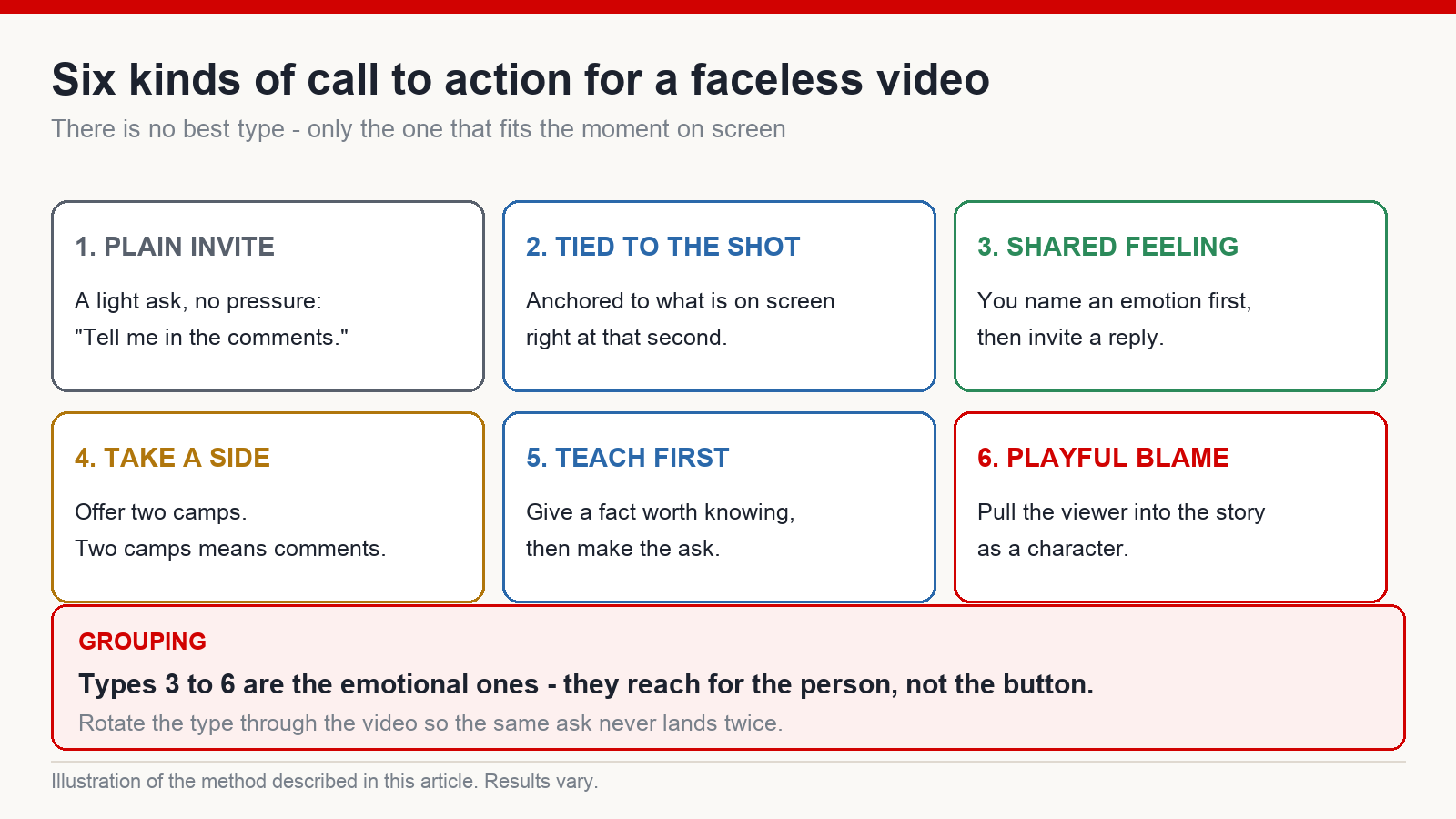
In the program I run, we work with six types. Do not memorise them as a list. Treat them as a tray of tools: as the video moves, you pick up whichever one fits.
1. The plain invite. A light ask with no pressure behind it. The herd is crossing the river, and you drop in: “if this looks as good to you as it does to me, leave me a comment.” No strain, no rushed delivery at the buzzer. Just a nudge.
2. Tied to the shot. You glue the ask to whatever is happening on screen at that second. The cheetah bursts out of the grass and you say, immediately: “hit like if that made you hold your breath.” Because the ask is attached to the shot, it does not feel like an interruption.
3. Shared feeling. You name an emotion before you ask for anything. “This lost cub reminds me of the first time I got turned around in a city I did not know. Anyone else?” The viewer sees themselves in the sentence, and people who see themselves want to say so.
4. Take a side. You put two camps on the table. “Plenty of people argue the hyena is the animal to fear out here, not the lion. Where do you land?” Two camps reliably produce comments, because disagreeing is easier than composing praise.
5. Teach first. You hand over something worth knowing, then make the ask. “Elephants sleep less than two hours a day. If you learned something here, drop a like.” They receive before they give.
6. Playful blame. You pull the viewer into the story as a character instead of leaving them in the seat. This one lands hardest, and I will come back to it in detail.
The last four – shared feeling, take a side, teach first, playful blame – are the emotional group. They reach for the person, not the button.
What I want you to hold onto is that there is no best type, only the one that fits the section. A plain invite for the opening. A take-a-side for the peak. A teach-first for the quiet stretch. That is what gives a video rhythm. Run the same type three times and the audience tunes it out by the second one.
Timing: one ask in the first minute, then roughly every five
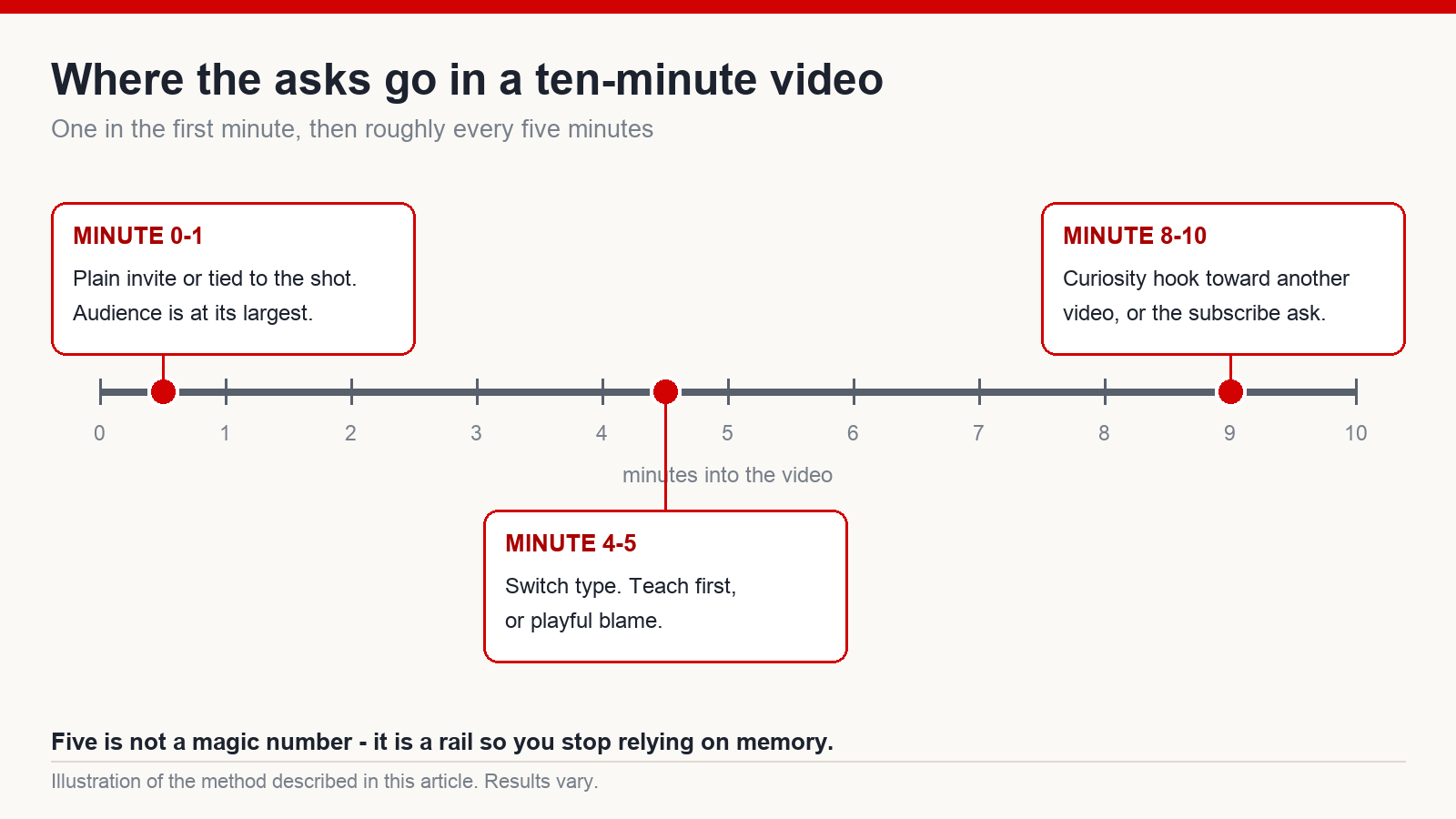
Knowing how to ask is half of it. The harder half is when. This is where most creators drift. One video gets an ask up front, the next gets one only because you remembered near the end, the third gets none at all. When the channel runs on mood, engagement runs on your mood too.
So I turned the vague part into a rule. Ask once inside the first minute, while the audience is at its largest and nobody has scrolled away yet. Then repeat roughly every five minutes: around minute four or five, around minute eight to ten, and onward for longer videos.
Five is not a sacred number. It is a rail. It exists so you stop deciding from scratch on every edit.
The method is deliberately mechanical. Before you write the script, sketch a timeline of the video and mark the ask points on it: one dot in the first minute, one at four to five, one at eight to ten. When your writing reaches a dot, you write the invitation there. Nothing gets forgotten because nothing was left to memory.
On a faceless channel the first minute is the easiest one to fumble. With no face to greet anyone with, a badly placed ask sounds bolted on and breaks the flow. The fix is the same principle as type two: anchor the ask to what is being said and shown right then. And strip it down to a single keystroke – “type a 1 in the comments if you saw that coming” – so it is done before laziness has a chance to arrive.
One warning. The rule is a rail, not a metronome. Do not read this, get excited, and start asking every two minutes. Viewers find that irritating and irritated viewers leave, which undoes the whole point. Keep the spacing wide and even.
The rule underneath everything: one action at a time
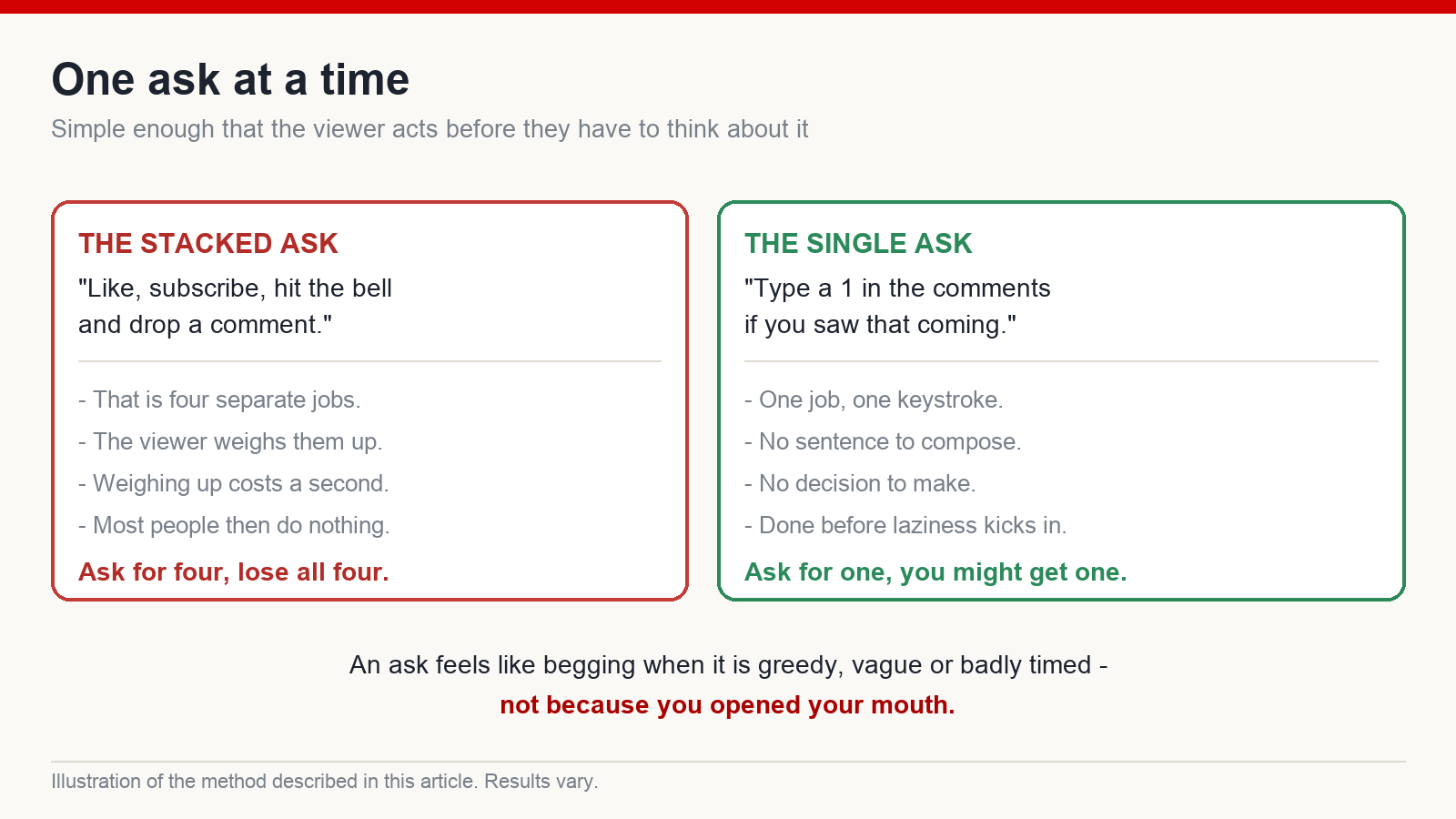
If you keep one sentence from this article, keep this one: each time you ask, ask for exactly ONE action.
It runs against instinct. You have gone to the trouble of opening your mouth, so why not collect everything at once: “remember to like, subscribe, hit the bell and leave a comment.” It sounds thorough. To the viewer it is four separate jobs. And an effective ask has to be simple enough that someone does it without stopping to think. The moment they have to weigh options, you have lost.
The most common version of this trap is “like and subscribe”. It sounds like one sentence. It is two actions. And here is the sting: when people have to choose between two things, they hesitate, and hesitation usually resolves into doing neither. Ask for two, you often lose both. Ask for one, you have a shot at one.
Think about your own behaviour while scrolling. You do the thing that is easy enough to require no decision. Your audience is exactly the same. So your job is to drive friction as close to zero as it will go: reduce the ask to a single keystroke. Instead of “share your thoughts in the comments”, I ask people to “type a 1”. One key. No sentence to compose. Anyone can manage it.
And this closes the loop on the discomfort we started with. What makes an ask feel like begging is not the fact that you asked. It is asking greedily, vaguely or at the wrong moment. Ask for little, ask clearly, ask at the right time, and it reads as a decent invitation. People are not annoyed by being invited. They are annoyed by being demanded of.
Three techniques that hit harder, and the line you do not cross
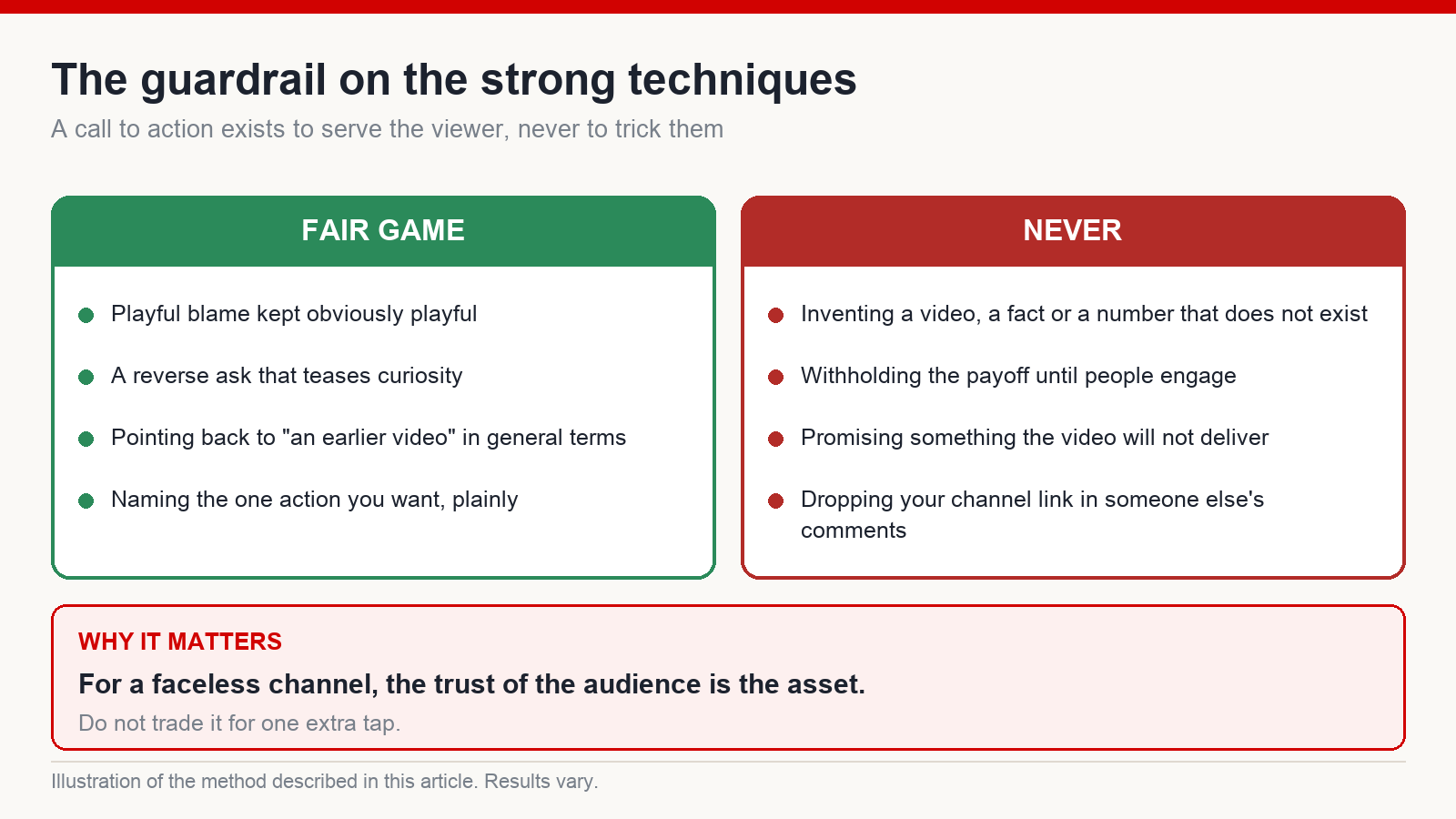
These three land harder than a gentle “don’t forget to like”. The faster the car, the more the guardrail matters, so I am putting the guardrail right beside each corner rather than at the end.
The reverse ask. Instead of asking for a like, ask for a dislike, or say something like “do not keep watching if you would rather not know why this hunt failed”. It sounds backwards, and the backwardness is the point: the viewer is curious and mildly argumentative at the same time, and the thumb moves on its own. Human brains dislike being told not to.
Playful blame. This is the strongest of the three. Mid-scene, flatly: “that lion just lost its dinner, and honestly, that is because you have not hit like yet.” In one line the viewer stops being an observer and becomes a character with a stake in what is unfolding. On a faceless animal channel, where you have no face to carry emotion, this is close to the tightest connection available to you.
The curiosity hook. One arrow, two targets. You reference “an earlier video” in general terms – “in the previous one you saw what happens when…” – and viewers go looking. Target one: they spend longer on the channel. Target two, which almost nobody notices: you have just measured demand. If a wave of people arrive asking where that video is, you have your next production brief, handed to you by the audience.
Now the guardrail, and I will only say it once, in bold terms. A call to action exists to serve and connect with the audience, not to trap them. A curiosity hook may only gesture at “an earlier video” in general terms – never invent a video, never invent a statistic, never promise something you do not have. Playful blame and reverse asks have to stay obviously playful; the moment they turn into manipulation they stop being clever. And when you visit a competitor’s channel to read comments and understand their audience, never leave a comment fishing for attention or dropping a link back to your own channel. That is a fast route to losing everything you built.
Remember what a channel actually risks here. Monetization gets switched off over content judged to be inauthentic or misleading, and review systems are getting stricter, not looser. Building your asks on small deceptions walks you straight toward that risk. For a faceless channel, credibility with the audience is close to the only long-term asset you own. Do not trade it for one extra tap.
A ten-minute map you can use on your next upload
Enough theory. Here is everything assembled into something you can carry into the edit. Picture a ten-minute video with three stops.
Minute 0 to 1. Place the first ask right after the opening – plain invite or tied to the shot, glued to whatever is on screen. One action only, friction as low as it goes: “type a 1 for me if you are already holding your breath waiting for that cat to move.” One key. Catch engagement early, while the audience is at its largest.
Minute 4 to 5. The middle ask. Switch type so it does not go stale – teach first, or playful blame. Still one action, this time a like: “that lion just lost its dinner, and part of that is on you for not hitting like.”
Minute 8 to 10. The closing ask. Curiosity hook toward another video, one action: keep watching, or subscribe. Reference “an earlier video” in general terms so people go looking, which stretches watch time and measures demand at the same time.
And the five-step checklist to tape above the editing desk:
- Pick ONE primary action for the whole video.
- Write the first-minute ask so it sits inside the opening content, not on top of it.
- Mark the roughly-five-minute points in advance and rotate the type at each one.
- If you use a strong technique – reverse ask, playful blame – reread it and ask honestly whether it misleads anyone.
- Final pass: any invented numbers? Any promise the video does not keep?
Go back to the scene we opened with, the one where your hand stopped because it felt like begging. This time it is different. You opened your mouth at the right moment, decently, and asked for exactly one thing. The viewer stops the thumb, types a 1, and stays a little longer. Asked well, it stops being a plea and becomes a handshake.
Your turn. Pick one type right now and write one ask into the first minute of your next video. One. And whichever technique you reach for, hold the line: ask to serve, never to deceive.
How many calls to action should one video have?
Use the rail: one inside the first minute, then roughly one every five minutes. A ten-minute video lands at around three. Do not squeeze one in every two minutes – the audience finds it tiring, and once they leave, the number of asks stops mattering.
How do you make an ask sound natural on a faceless channel?
Anchor it to what is happening on screen instead of dropping a dry “like and subscribe” into a gap. The cheetah misses its target, and you ask right then. Then reduce it to a single keystroke, like “type a 1”, so your voice – the only thing the audience has to hold onto – does the connecting work.
Is playful blame or a reverse ask manipulative?
The line is whether you are deceiving anyone. Keep it obviously playful, invent no statistics, promise nothing you do not deliver, and it is a healthy way to reach someone emotionally. Fabricate a story to extract engagement and it becomes manipulation, which is the shortest path to being labelled inauthentic.
Should I ask for likes, subscribes or comments first?
There is no answer that holds for every video. The principle is one thing per ask, and choose whichever action is easiest at that point. Early on, when the viewer barely knows you, a one-keystroke comment is usually the lowest bar. Later, once they have stayed long enough to value the content, the subscribe ask makes more sense.
An audience does not engage with someone who never invited them. Open your mouth first, honestly, and then listen to what comes back.
Written by Phuc, a YouTube trainer who has been building on the platform since 2017 (nine years) and works mainly with faceless channels aimed at English-speaking audiences in the US, UK, Germany and Japan. The framework above is what I use on my own channels and teach to the creators I work with.
The full step-by-step system I run with those creators lives at mmoyoutube.com.
Disclaimer: this article shares personal experience and method, not a promise of views, revenue or growth. Results vary and YouTube’s policies change over time. Nothing here should be read as financial advice.